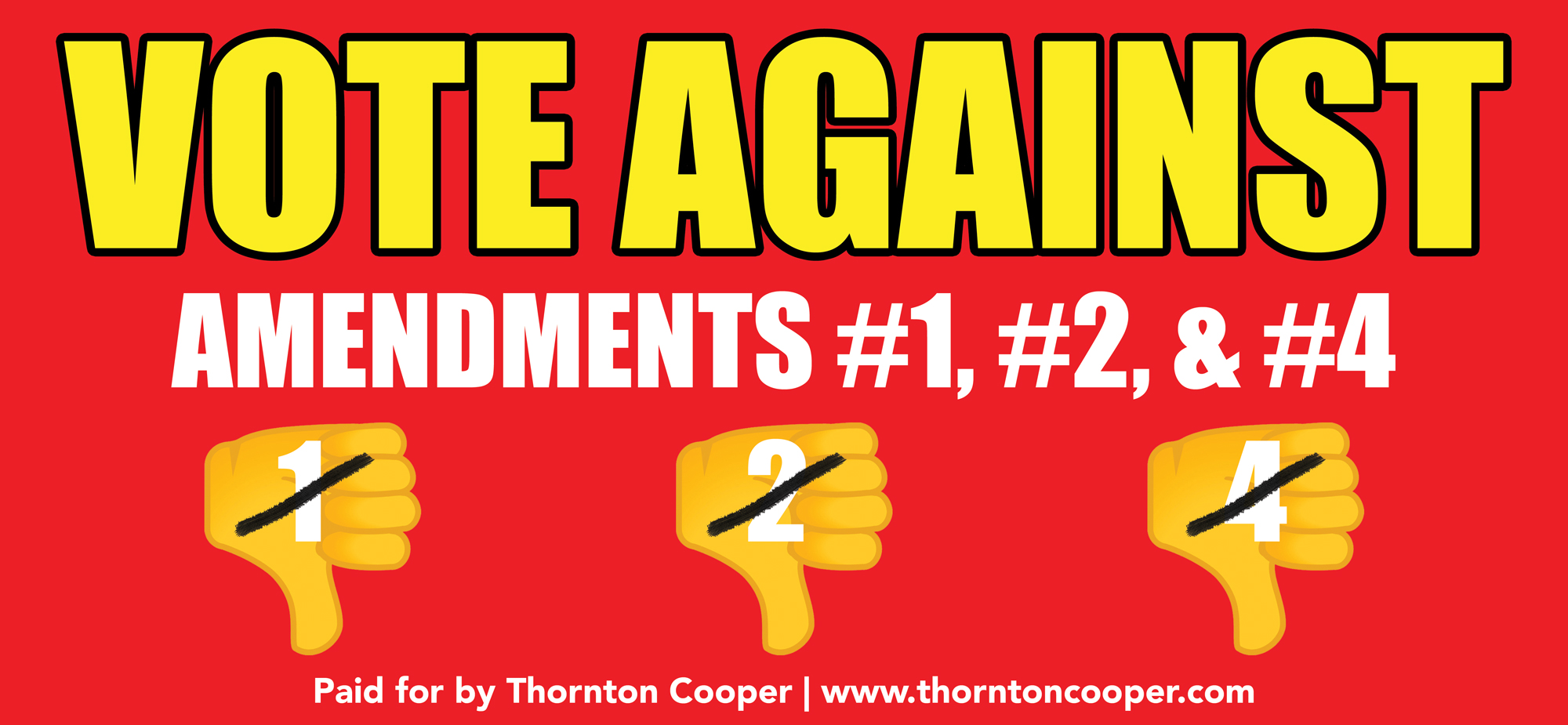
General Election: Tuesday, November 8, 2022 Read below for the texts of the 3 resolutions drafted by Thornton Cooper and adopted by the West Virginia Democratic Party on August 27, 2022, with respect to proposed Amendment No. 1, proposed Amendment No. 2, and proposed Amendment No. 4 that will be on the November 8, 2022, general-election ballot. (The actual TEXT of each amendment will NOT be on the ballot.) RESOLUTION ON PROPOSED AMENDMENT NO. 1 ON THE NOVEMBER 8, 2022, GENERAL-ELECTION BALLOT: THE “CLARIFICATION OF THE JUDICIARY'S ROLE IN IMPEACHMENT PROCEEDINGS AMENDMENT”. WHEREAS, in 2018, the West Virginia Legislature conducted an investigation that led to the commencement of impeachment proceedings against the five (5) Justices on the Supreme Court of Appeals of West Virginia; and WHEREAS, one of those Justices, Margaret Workman, filed a petition before that Court for relief with respect to certain aspects of the impeachment proceedings; and WHEREAS, five acting Justices were appointed to review her petition; and WHEREAS, on October 11, 2018, in the case of State ex rel. Workman v. Carmichael, those acting Justices filed a majority opinion and a concurring opinion with respect to the issues raised in her petition; and WHEREAS, all five of the acting Justices in that case agreed that that Court has the exclusive authority and jurisdiction under Article VIII, § 8 of the West Virginia Constitution and the rules promulgated thereunder, to sanction a judicial officer for a violation of a Canon of the West Virginia Code of Judicial Conduct, and that the Separation of Powers Clause of Article V, § 1 of the West Virginia Constitution prohibits a Court of Impeachment from prosecuting a judicial officer for an alleged violation of the Code of Judicial Conduct; and WHEREAS, a majority of the acting Justices in that case also ruled that the Due Process Clause of Article III, § 10 of the Constitution of West Virginia requires the House of Delegates to follow the procedures that it creates to impeach a public officer and that failure to follow such rules will invalidate all Articles of Impeachment that it returns against a public officer; and WHEREAS, on February 11, 2021, a resolution, designated House Joint Resolution 2, was introduced in the House of Delegates for the purpose of amending Article IV, § 9 of the West Virginia Constitution to prevent any court in West Virginia from granting any relief in impeachment proceedings in the House of Delegates or Senate; and WHEREAS, under said House Joint Resolution 2, Article IV, § 9 of the West Virginia Constitution would be rewritten, with strike-throughs used to indicate language that would be stricken and underscoring used to indicate language that would be added, to read as follows: ARTICLE IV. §9. Impeachment of officials. Any officer of the state may be impeached for maladministration, corruption, incompetency, gross immorality, neglect of duty, or any high crime or misdemeanor. The House of Delegates WHEREAS, according to the Ballotpedia website, the West Virginia House of Delegates approved House Joint Resolution 2 on March 2, 2021, by a vote of 78 to 21, and one not voting, with 76 Republicans and 2 Democrats voting for, 21 Democrats voting against, and one Republican not voting; and WHEREAS, according to the Ballotpedia website, the West Virginia State Senate approved House Joint Resolution 2 on April 9, 2021, by a vote of 23 to 11, with all 23 Republicans voting for, and all 11 Democrats voting against; and WHEREAS, under House Joint Resolution 2, the title of the proposed amendment is the “Clarification of the Judiciary's Role in Impeachment Proceedings Amendment” and the purpose of the proposed amendment is summarized as a follows: “Clarifying that courts have no authority or jurisdiction to intercede or intervene in or interfere with impeachment proceedings of the House of Delegates or the Senate; and specifying that a judgment rendered by the Senate following an impeachment trial is not reviewable by any court of this state”; and WHEREAS, the West Virginia Secretary of State's Office has decided to number this proposed amendment as Amendment No. 1 on the November 8, 2022, general-election ballot; and WHEREAS, in the opinion of the West Virginia Democratic Party, the ratification of Amendment No. 1 would disrupt the existing separation of powers by improperly expanding the power of West Virginia's legislative branch at the expense of West Virginia's judicial branch, and by weakening the ability of the courts of West Virginia to protect individuals who are the subjects of impeachment proceedings from being denied fair hearings and due process. NOW, THEREFORE, BE IT RESOLVED that the WEST VIRGINIA DEMOCRATIC PARTY, through its governing body, the WEST VIRGINIA STATE DEMOCRATIC EXECUTIVE COMMITTEE, hereby OPPOSES THE RATIFICATION OF AMENDMENT NO. 1, the “Clarification of the Judiciary's Role in Impeachment Proceedings Amendment”, and urges the voters of West Virginia to VOTE AGAINST Amendment No. 1 on the general-election ballot; and IT IS ORDERED that copies of this RESOLUTION, as adopted, be transmitted and distributed to newspapers and other media throughout the state of West Virginia. RESOLUTION ON PROPOSED AMENDMENT NO. 2 ON THE NOVEMBER 8, 2022, GENERAL-ELECTION BALLOT: THE “PROPERTY TAX MODERNIZATION AMENDMENT”. WHEREAS, as a result of the ratification in 1932 of the Tax Limitation Amendment, as subsequently amended, West Virginia has some of the lowest property taxes in the United States; and WHEREAS, property taxes that are subject to the provisions of the Tax Limitation Amendment, as subsequently amended, are a major source of revenue for county boards of education, county commissions, and municipal corporations; and WHEREAS, for years certain business interests have requested that personal property directly used in business activity in West Virginia be exempted from taxation without at the same time requesting a corresponding increase in tax revenues from other explicit sources in a manner that would ensure that the effect of exempting personal property directly used in business activity in West Virginia from taxation would be revenue- neutral and would not reduce the overall tax revenues that support the services provided by county boards of education, county commissions, and municipal corporations; and WHEREAS, on February 11, 2021, a resolution, designated House Joint Resolution 3, was introduced in the House of Delegates for the purpose of amending the West Virginia Constitution to give the Legislature much broader authority over property taxation; and WHEREAS, on March 26, 2021, the House Judiciary Committee reported out Committee Substitute for House Joint Resolution 3, in which the language from the original resolution was rewritten and replaced with language that would amend Article X, § 1 of the West Virginia Constitution to authorize the Legislature to enact legislation to exempt tangible machinery and equipment personal property directly used in business activity and tangible inventory personal property directly used in business activity from taxation; and WHEREAS, on March 30, 2021, the House of Delegates adopted a floor amendment that would expand the scope of the resolution to include authorizing the Legislature to enact legislation to exempt motor vehicles from personal-property taxation; and WHEREAS, on March 31, 2021, the House of Delegates adopted the resolution, as amended; and WHEREAS, under Committee Substitute for House Joint Resolution 3, as amended, Article X, § 1 of the West Virginia Constitution would be rewritten, with underscoring used to indicate language that would be added, to read as follows: ARTICLE X. §1. Taxation and finance. Subject to the exceptions in this section contained, taxation shall be equal and uniform throughout the state, and all property, both real and personal, shall be taxed in proportion to its value to be ascertained as directed by law. No one species of property from which a tax may be collected shall be taxed higher than any other species of property of equal value; except that the aggregate of taxes assessed in any one year upon personal property employed exclusively in agriculture, including horticulture and grazing, products of agriculture as above defined, including livestock, while owned by the producer, and money, notes, bonds, bills and accounts receivable, stocks and other similar intangible personal property shall not exceed fifty cents on each one hundred dollars of value thereon and upon all property owned, used and occupied by the owner thereof exclusively for residential purposes and upon farms occupied and cultivated by their owners or bona fide tenants, one dollar; and upon all other property situated outside of municipalities, one dollar and fifty cents; and upon all other property situated within municipalities, two dollars; and the Legislature shall further provide by general law for increasing the maximum rates, authorized to be fixed, by the different levying bodies upon all classes of property, by submitting the question to the voters of the taxing units affected, but no increase shall be effective unless at least sixty percent of the qualified voters shall favor such increase, and such increase shall not continue for a longer period than three years at any one time, and shall never exceed by more than fifty percent the maximum rate herein provided and prescribed by law; and the revenue derived from this source shall be apportioned by the Legislature among the levying units of the state in proportion to the levy laid in said units upon real and other personal property; but property used for educational, literary, scientific, religious or charitable purposes, all cemeteries, public property, tangible machinery and equipment personal property directly used in business activity, tangible inventory personal property directly used in business activity, personal property tax on motor vehicles, the personal property, including livestock, employed exclusively in agriculture as above defined and the products of agriculture as so defined while owned by the producers may by law be exempted from taxation; household goods to the value of two hundred dollars shall be exempted from taxation. The Legislature shall have authority to tax privileges, franchises, and incomes of persons and corporations and to classify and graduate the tax on all incomes according to the amount thereof and to exempt from taxation incomes below a minimum to be fixed from time to time, and such revenues as may be derived from such tax may be appropriated as the Legislature may provide. After the year nineteen hundred thirty-three, the rate of the state tax upon property shall not exceed one cent upon the hundred dollars valuation, except to pay the principal and interest of bonded indebtedness of the state now existing. and WHEREAS, according to the Ballotpedia website, the West Virginia House of Delegates approved Committee Substitute for House Joint Resolution 3 on March 31, 2021, by a vote of 84 to 16, with 76 Republicans and 8 Democrats voting for and 15 Democrats and one Republican voting against; and WHEREAS, when the resolution was reported to the West Virginia State Senate, the Senate Judiciary Committee, at one point, offered an amendment that would have completely rewritten the resolution to create a sales tax option for counties, but later withdrew that amendment; and WHEREAS, on April 10, 2021, the West Virginia State Senate, after all proposed amendments were withdrawn, approved House-approved version, by a vote of 29 to 5, with 22 Republicans and 7 Democrats voting for, and 4 Democrats and one Republican voting against; and WHEREAS, under Committee Substitute for House Joint Resolution 3, the title of the proposed amendment is the “Property Tax Modernization Amendment” and the purpose of the proposed amendment is summarized as follows: “To amend the State Constitution by providing the Legislature with authority to exempt tangible machinery and equipment personal property directly used in business activity and tangible inventory personal property directly used in business activity and personal property tax on motor vehicles from ad valorem property taxation by general law”; and WHEREAS, the West Virginia Secretary of State's Office has announced that it is going to number this proposed amendment as Amendment No. 2 on the November 8, 2022, general-election ballot; and WHEREAS, the effect of proposed Amendment No. 2, if ratified, would be to authorize the Legislature to enact legislation that could remove hundreds of millions of dollars of property-tax revenues per year from the total tax revenues per year that would otherwise be flowing to county boards of education, county commissions, and municipal corporations across West Virginia without at the same time requiring the Legislature to replace these tax revenues with tax revenues from other sources; and WHEREAS, for example, according to the website of the West Virginia Center on Budget and Policy, information from the West Virginia Association of Counties indicates that “2021 property tax revenue included $219 million from business machinery and equipment, $84 million from business inventory, $26 million from other business personal property, $136 million from personal vehicles, and $50 million from ‘supplemental’ property taxes, or taxes that were owed from previous years but paid in TY 2021, summing to a total of $515 million“; and WHEREAS, in the opinion of the West Virginia Democratic Party, the ratification of proposed Amendment No. 2 (a) would probably lead to the enactment of legislation that would jeopardize the ability of county boards of education, county commissions, and municipal corporations to continue to provide the levels of service that they are currently providing to the people of West Virginia, (b) would centralize more power in the state government in Charleston and erode the powers of county boards of education, county commissions, and municipal corporations in all 55 counties, and/or (c) conversely, might also lead to the enactment of legislation that would greatly increase the amount of real- estate taxes that the average West Virginia resident would pay per year. NOW, THEREFORE, BE IT RESOLVED that the WEST VIRGINIA DEMOCRATIC PARTY, through its governing body, the WEST VIRGINIA STATE DEMOCRATIC EXECUTIVE COMMITTEE, hereby OPPOSES THE RATIFICATION OF AMENDMENT NO. 2, the “Property Tax Modernization Amendment”, and urges the voters of West Virginia to VOTE AGAINST Amendment No. 2 on the general-election ballot; and IT IS ORDERED that copies of this RESOLUTION be transmitted and distributed to newspapers and other media throughout the state of West Virginia. RESOLUTION ON PROPOSED AMENDMENT NO. 4 ON THE NOVEMBER 8, 2022, GENERAL-ELECTION BALLOT: THE “EDUCATION ACCOUNTABILITY AMENDMENT”. WHEREAS, in 1958 the West Virginia voters ratified the Better Schools Amendment, which replaced the elected position of State Superintendent of Free Schools chosen by the voters with a State Superintendent of Free Schools chosen by a nine-member West Virginia Board of Education; and WHEREAS, as a result of the ratification of the Better Schools Amendment, the members of the West Virginia Board of Education are appointed to staggered 9-year terms by the Governor, with the advice and consent of the West Virginia State Senate, with no more five (5) members of the Board belonging to the same political party; and WHEREAS, the ratification of the Better Schools Amendment in 1958 and the continuation of 55 nonpartisan county school boards have created a public school system that has, until recently, been relatively immune from the pressures of partisan politics; and WHEREAS, in 1989, the West Virginia Legislature placed on a special-election ballot a proposed constitutional amendment, called the Education Reorganization Amendment, under which the State Superintendent of Schools would have been eliminated as a constitutional office and under which the West Virginia Board of Education would have been eliminated as a constitutional board; and WHEREAS, at a special election held on September 9, 1989, the voters of West Virginia overwhelmingly rejected the Education Reorganization Amendment by a vote of 220,286 to 29,776, according to the West Virginia Blue Book; and WHEREAS, after that special election, the West Virginia Democratic Party, in its leadership of the West Virginia Legislature, respected the clear will of the voters, honored the nonpartisan nature of the West Virginia Board of Education, and generally refrained from attempting to weaken that Board; and WHEREAS, however, since its acquisition of supermajority control over the Legislature, the West Virginia Republican Party has attempted to expand the power of the Legislature into areas that for decades have been considered off-limits; and WHEREAS, on January 13, 2022, a resolution, designated House Joint Resolution 102, was introduced in the House of Delegates for the purpose of amending Article XII, § 2 of the West Virginia Constitution to make the policies and rules of the West Virginia Board of Education subject to legislative review; and WHEREAS, under said House Joint Resolution 102, Article XII, § 2 of the West Virginia Constitution would be rewritten, with strike-throughs used to indicate language that would be stricken and underscoring used to indicate language that would be added, to read as follows: ARTICLE XII. EDUCATION. §2. Supervision of free schools. Subject to the provisions of this section, WHEREAS, on February 22, 2022, the West Virginia House of Delegates initially approved House Joint Resolution 102; and WHEREAS, on February 28, 2022, according to the Ballotpedia website the West Virginia State Senate approved House Joint Resolution 102 with a technical amendment, by a vote of 23 to 11, with 22 Republicans and one Democrat voting for and 10 Democrats and one Republican voting against; and WHEREAS, according to the Ballotpedia website, the West Virginia House of Delegates approved House Joint Resolution 102, with the technical amendment, on March 3, 2023, by a vote of 74 to 20, and 6 not voting, with 73 Republicans and one Democrat voting for, 20 Democrats voting against, and 5 Republicans and one Democrat not voting; and WHEREAS, under House Joint Resolution 102, the title of the proposed amendment is the “Education Accountability Amendment” and the purpose of the proposed amendment is summarized as follows: “The purpose of this amendment is to clarify that the rules and policies promulgated by the State Board of Education, are subject to legislative review, approval, amendments, or rejection.”; and WHEREAS, the West Virginia Secretary of State's Office has decided to number this proposed amendment as Amendment No. 4 on the November 8, 2022, general-election ballot; and WHEREAS, in the opinion of the West Virginia Democratic Party, the ratification of proposed Amendment No. 4 would disrupt the existing separation of powers by improperly expanding the power of West Virginia's increasingly partisan legislative branch at the expense of the nonpartisan West Virginia Board of Education, which is part of West Virginia's executive branch, would severely weaken the ability of the West Virginia Board of Education to supervise the state's 55 county school systems, and would erode the stability of, and public faith in, West Virginia's system of public education. NOW, THEREFORE, BE IT RESOLVED that the WEST VIRGINIA DEMOCRATIC PARTY, through its governing body, the WEST VIRGINIA STATE DEMOCRATIC EXECUTIVE COMMITTEE, hereby OPPOSES THE RATIFICATION OF AMENDMENT NO. 4, the “Education Accountability Amendment”, and urges the voters of West Virginia to VOTE AGAINST Amendment No. 4 on the general-election ballot; and IT IS ORDERED that copies of this RESOLUTION, as adopted, be transmitted and distributed to newspapers and other media throughout the state of West Virginia. |
|
Thanks for visiting ThorntonCooper.com
Thornton Cooper is a native and
resident of South Charleston, an
attorney, and a retired state employee.
Between 2006 and 2015 Mr. Cooper
served on the Kanawha County
Democratic Executive Committee
(KCDEC), as a committeeman
representing Executive Committee
District 2-B. Since 2011, he has also
been serving as a committeeman for
his ward on the South Charleston
Democratic Executive Committee
(SCDEC) and as the Secretary of the
SCDEC. He is currently the Acting
Chairman of the SCDEC.
For decades, Thornton Cooper has, as
a private citizen, taken public
positions on dozens of matters of
public interest. He has also
commenced, or intervened in, several
court proceedings on such matters as
redistricting, gubernatorial succession,
the Charleston “user fee”, school
consolidation, and the proper
procedures for amending the West
Virginia Constitution.
Following the 1980, 1990, 2000,
2010, and 2020 Censuses, he
developed proposals for redistricting
West Virginia's congressional
districts, and following the 2010 and
2020 Censuses, he also developed
proposals for redistricting the State
Senate and the House of Delegates.
He has supported raising the minimum
wage, protecting the safety of the
state's drinking water, and preserving
state laws relating to the disposal of
solid waste.
He campaigned against a law passed
in 2014 that allows concealed
weapons to be brought into city
recreation facilities in Kanawha
County. He believes that city
governments should have the right to
ban concealed weapons in such
facilities.
Mr. Cooper, now 72, was born and
raised in South Charleston. His
brothers Tom (now deceased) and
John and he attended public schools
there. After graduating from South
Charleston High School in 1968, he
attended Yale University. In 1972, he
graduated from Yale with a B. A. in
Political Science. Between 1975 and
1978, he attended the West Virginia
University College of Law, where he
received his law degree (Juris Doctor)
in 1978.
His parents, now deceased, were
Thomas R. Cooper, Sr., an electrical
engineer and draftsman at the Union
Carbide Technical Center in South
Charleston, and Virginia Watson
Cooper, who taught English and Latin
at South Charleston Junior High
School, Stonewall Jackson High
School, and George Washington High
School.
Thornton Cooper has two sons:
Jeremy, 40, who graduated from
Charleston Catholic High School,
Oberlin College, and the West
Virginia University College of Law (J.
D. 2013), now practices law in West
Virginia and Pennsylvania and lives
with his wife Lacy, daughter Virginia,
and son Jude in Pittsburgh. Timothy,
36, a composer who graduated from
George Washington High School and
West Virginia University, received his
master's degree from the University of
Tennessee, and worked on his
doctorate at the University of
Hartford, now works for a music
company and lives with his wife Pam,
daughter Larkin, and son Zane in
Ohio.
PUBLIC SERVICE
Thornton Cooper worked for over 29
years for several state agencies,
including the West Virginia
Department of Highways, the West
Virginia Human Rights Commission,
and the Public Service Commission of
West Virginia. For nearly 25 years of
this period, Mr. Cooper was an
attorney and administrator for the
Public Service Commission. At the
end of 2005, he retired as an employee
of that agency. During 2006, he also
worked for the Commission as an independent contractor.
During the last 40+ years, Mr. Cooper has appeared before the state Supreme Court in about 30 cases. He has also appeared in federal court several times. |